Proxy of C++ lvars_t class.
|
| "int" | find_input_lvar (self, *args) |
| | find_input_lvar(self, argloc, _size) -> int Find input variable at the specified location.
|
| |
| "int" | find_stkvar (self, *args) |
| | find_stkvar(self, spoff, width) -> int Find stack variable at the specified location.
|
| |
| "lvar_t *" | find (self, *args) |
| | find(self, ll) -> lvar_t Find variable at the specified location.
|
| |
| "int" | find_lvar (self, *args) |
| | find_lvar(self, location, width, defblk=-1) -> int Find variable at the specified location.
|
| |
| | __init__ (self, *args) |
| | init(self) -> lvars_t
|
| |
| "lvar_t &" | push_back (self, *args) |
| | push_back(self, x)
|
| |
| "void" | pop_back (self, *args) |
| | pop_back(self)
|
| |
| "size_t" | size (self, *args) |
| | size(self) -> size_t
|
| |
| "bool" | empty (self, *args) |
| | empty(self) -> bool
|
| |
| "lvar_t const &" | at (self, *args) |
| | at(self, _idx) -> lvar_t
|
| |
| "void" | qclear (self, *args) |
| | qclear(self)
|
| |
| "void" | clear (self, *args) |
| | clear(self)
|
| |
| "void" | resize (self, *args) |
| | resize(self, _newsize, x)
|
| |
| "void" | grow (self, *args) |
| | grow(self, x=lvar_t())
|
| |
| "size_t" | capacity (self, *args) |
| | capacity(self) -> size_t
|
| |
| "void" | reserve (self, *args) |
| | reserve(self, cnt)
|
| |
| "void" | truncate (self, *args) |
| | truncate(self)
|
| |
| "void" | swap (self, *args) |
| | swap(self, r)
|
| |
| "lvar_t *" | extract (self, *args) |
| | extract(self) -> lvar_t
|
| |
| "void" | inject (self, *args) |
| | inject(self, s, len)
|
| |
| "bool" | __eq__ (self, *args) |
| | eq(self, r) -> bool
|
| |
| "bool" | __ne__ (self, *args) |
| | ne(self, r) -> bool
|
| |
| "qvector< lvar_t >::const_iterator" | begin (self, *args) |
| | begin(self) -> lvar_t
|
| |
| "qvector< lvar_t >::const_iterator" | end (self, *args) |
| | end(self) -> lvar_t
|
| |
| "qvector< lvar_t >::iterator" | insert (self, *args) |
| | insert(self, it, x) -> lvar_t
|
| |
| "qvector< lvar_t >::iterator" | erase (self, *args) |
| | erase(self, it) -> lvar_t
|
| |
| "bool" | has (self, *args) |
| | has(self, x) -> bool
|
| |
| "bool" | add_unique (self, *args) |
| | add_unique(self, x) -> bool
|
| |
| "size_t" | __len__ (self, *args) |
| | len(self) -> size_t
|
| |
| "lvar_t const &" | __getitem__ (self, *args) |
| | getitem(self, i) -> lvar_t
|
| |
| "void" | __setitem__ (self, *args) |
| | setitem(self, i, v)
|
| |
|
| | thisown = property(lambda x: x.this.own(), lambda x, v: x.this.own(v), doc="The membership flag") |
| |
| | thisown = property(lambda x: x.this.own(), lambda x, v: x.this.own(v), doc="The membership flag") |
| |
◆ __init__()
| __init__ |
( |
| self, |
|
|
* | args ) |
◆ find()
| "lvar_t *" find |
( |
| self, |
|
|
* | args ) |
- Parameters
-
- Returns
- : pointer to variable or nullptr
Reimplemented from qvector_lvar_t.
◆ find_input_lvar()
| "int" find_input_lvar |
( |
| self, |
|
|
* | args ) |
- Parameters
-
| argloc | (C++: const vdloc_t &) variable location |
| _size | (C++: int) variable size |
- Returns
- : -1 if failed, otherwise the index into the variables vector.
◆ find_lvar()
| "int" find_lvar |
( |
| self, |
|
|
* | args ) |
- Parameters
-
| location | (C++: const vdloc_t &) variable location |
| width | (C++: int) variable size |
| defblk | (C++: int) definition block of the lvar. -1 means any block |
- Returns
- : -1 if failed, otherwise the index into the variables vector.
◆ find_stkvar()
| "int" find_stkvar |
( |
| self, |
|
|
* | args ) |
- Parameters
-
| spoff | (C++: sval_t) offset from the minimal sp |
| width | (C++: int) variable size |
- Returns
- : -1 if failed, otherwise the index into the variables vector.
◆ thisown
| thisown = property(lambda x: x.this.own(), lambda x, v: x.this.own(v), doc="The membership flag") |
|
static |
The documentation for this class was generated from the following file:

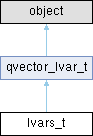
 Public Member Functions inherited from qvector_lvar_t
 1.12.0